Showing posts with label Science. Show all posts

PhotoSynthesis - Full Explanation

About PhotoSynthesis


Photosynthesis (English pronunciation: /foʊtoʊˈsɪnθəsɪs/; from the Greek φώτο- [photo-], "light," and σύνθεσις [synthesis], "putting together", "composition") is a process that converts carbon dioxide into organic compounds, especially sugars, using the energy from sunlight.[1] Photosynthesis occurs in plants, algae, and many species of bacteria, but not in archaea. Photosynthetic organisms are called photoautotrophs, since they can create their own food. In plants, algae, and cyanobacteria, photosynthesis uses carbon dioxide and water, releasing oxygen as a waste product. Photosynthesis is vital for all aerobic life on Earth. As well as maintaining the normal level of oxygen in the atmosphere, nearly all life either depends on it directly as a source of energy, or indirectly as the ultimate source of the energy in their food[2] (the exceptions are chemoautotrophs that live in rocks or around deep sea hydrothermal vents). The rate of energy capture by photosynthesis is immense, approximately 100 terawatts,[3] which is about six times larger than the power consumption of human civilization.[4] As well as energy, photosynthesis is also the source of the carbon in all the organic compounds within organisms' bodies. In all, photosynthetic organisms convert around 100–115 petagrams of carbon into biomass per year.[5][6]
Although photosynthesis can happen in different ways in different species, some features are always the same. For example, the process always begins when energy from light is absorbed by proteins called photosynthetic reaction centers that contain chlorophylls. In plants, these proteins are held inside organelles called chloroplasts, while in bacteria they are embedded in the plasma membrane. Some of the light energy gathered by chlorophylls is stored in the form of adenosine triphosphate (ATP). The rest of the energy is used to remove electrons from a substance such as water. These electrons are then used in the reactions that turn carbon dioxide into organic compounds. In plants, algae and cyanobacteria, this is done by a sequence of reactions called the Calvin cycle, but different sets of reactions are found in some bacteria, such as the reverse Krebs cycle in Chlorobium. Many photosynthetic organisms have adaptations that concentrate or store carbon dioxide. This helps reduce a wasteful process called photorespiration that can consume part of the sugar produced during photosynthesis.


Overview of cycle between autotrophs and heterotrophs. Photosynthesis is the main means by which plants, algae and many bacteria produce organic compounds and oxygen from carbon dioxide and water (green arrow).
The first photosynthetic organisms probably evolved about 3,500 million years ago, early in the evolutionary history of life, when all forms of life on Earth were microorganisms and the atmosphere had much more carbon dioxide. They most likely used hydrogen or hydrogen sulfide as sources of electrons, rather than water.[7] Cyanobacteria appeared later, around 3,000 million years ago, and drastically changed the Earth when they began to oxygenate the atmosphere, beginning about 2,400 million years ago.[8] This new atmosphere allowed the evolution of complex life such as protists. Eventually, no later than a billion years ago, one of these protists formed a symbiotic relationship with a cyanobacterium, producing the ancestor of many plants and algae.[9] The chloroplasts in modern plants are the descendants of these ancient symbiotic cyanobacteria.[10]

More About It


Overview


Photosynthesis changes the energy from the sun into chemical energy, splits water to liberate O2, and fixes CO2 into sugar.
Photosynthetic organisms are photoautotrophs, which means that they are repositories of energy, they are able to synthesize food directly from carbon dioxide using energy from light. They accrue it as part of their potential energy. However, not all organisms that use light as a source of energy carry out photosynthesis, since photoheterotrophs use organic compounds, rather than carbon dioxide, as a source of carbon.[2] In plants, algae and cyanobacteria, photosynthesis releases oxygen. This is called oxygenic photosynthesis. Although there are some differences between oxygenic photosynthesis in plants, algae and cyanobacteria, the overall process is quite similar in these organisms. However, there are some types of bacteria that carry out anoxygenic photosynthesis, which consumes carbon dioxide but does not release oxygen.
Carbon dioxide is converted into sugars in a process called carbon fixation. Carbon fixation is a redox reaction, so photosynthesis needs to supply both a source of energy to drive this process, and the electrons needed to convert carbon dioxide into a carbohydrate, which is a reduction reaction. In general outline, photosynthesis is the opposite of cellular respiration, where glucose and other compounds are oxidized to produce carbon dioxide, water, and release chemical energy. However, the two processes take place through a different sequence of chemical reactions and in different cellular compartments.
The general equation for photosynthesis is therefore:[dubious – discuss]
2n CO2 + 2n H2O + photons → 2(CH2O)n + n O2 + 2n A
Carbon dioxide + electron donor + light energy → carbohydrate + oxygen + oxidized electron donor
Since water is used as the electron donor in oxygenic photosynthesis, the equation for this process is:
2n CO2 + 2n H2O + photons → 2(CH2O)n + 2n O2
carbon dioxide + water + light energy → carbohydrate + oxygen
Other processes substitute other compounds (such as arsenite) for water in the electron-supply role; the microbes use sunlight to oxidize arsenite to arsenate:[11] The equation for this reaction is:
(AsO33–) + CO2 + photons → CO + (AsO43–)[12]
carbon dioxide + arsenite + light energy → arsenate + carbon monoxide (used to build other compounds in subsequent reactions)
Photosynthesis occurs in two stages. In the first stage, light-dependent reactions or light reactions capture the energy of light and use it to make the energy-storage molecules ATP and NADPH. During the second stage, the light-independent reactions use these products to capture and reduce carbon dioxide.
Most organisms that utilize photosynthesis to produce oxygen use visible light to do so, although at least three use infrared radiation.[13]
Photosynthetic membranes and organelles


Chloroplast ultrastructure:
1. outer membrane
2. intermembrane space
3. inner membrane (1+2+3: envelope)
4. stroma (aqueous fluid)
5. thylakoid lumen (inside of thylakoid)
6. thylakoid membrane
7. granum (stack of thylakoids)
8. thylakoid (lamella)
9. starch
10. ribosome
11. plastidial DNA
12. plastoglobule (drop of lipids)
Main articles: Chloroplast and Thylakoid
The proteins that gather light for photosynthesis are embedded within cell membranes. The simplest way these are arranged is in photosynthetic bacteria, where these proteins are held within the plasma membrane.[14] However, this membrane may be tightly folded into cylindrical sheets called thylakoids,[15] or bunched up into round vesicles called intracytoplasmic membranes.[16] These structures can fill most of the interior of a cell, giving the membrane a very large surface area and therefore increasing the amount of light that the bacteria can absorb.[15]
In plants and algae, photosynthesis takes place in organelles called chloroplasts. A typical plant cell contains about 10 to 100 chloroplasts. The chloroplast is enclosed by a membrane. This membrane is composed of a phospholipid inner membrane, a phospholipid outer membrane, and an intermembrane space between them. Within the membrane is an aqueous fluid called the stroma. The stroma contains stacks (grana) of thylakoids, which are the site of photosynthesis. The thylakoids are flattened disks, bounded by a membrane with a lumen or thylakoid space within it. The site of photosynthesis is the thylakoid membrane, which contains integral and peripheral membrane protein complexes, including the pigments that absorb light energy, which form the photosystems.
Plants absorb light primarily using the pigment chlorophyll, which is the reason that most plants have a green color. Besides chlorophyll, plants also use pigments such as carotenes and xanthophylls.[17] Algae also use chlorophyll, but various other pigments are present as phycocyanin, carotenes, and xanthophylls in green algae, phycoerythrin in red algae (rhodophytes) and fucoxanthin in brown algae and diatoms resulting in a wide variety of colors.
These pigments are embedded in plants and algae in special antenna-proteins. In such proteins all the pigments are ordered to work well together. Such a protein is also called a light-harvesting complex.
Although all cells in the green parts of a plant have chloroplasts, most of the energy is captured in the leaves. The cells in the interior tissues of a leaf, called the mesophyll, can contain between 450,000 and 800,000 chloroplasts for every square millimeter of leaf. The surface of the leaf is uniformly coated with a water-resistant waxy cuticle that protects the leaf from excessive evaporation of water and decreases the absorption of ultraviolet or blue light to reduce heating. The transparent epidermis layer allows light to pass through to the palisade mesophyll cells where most of the photosynthesis takes place.
Light reactions


Light-dependent reactions of photosynthesis at the thylakoid membrane
Main article: Light-dependent reactions
In the light reactions, one molecule of the pigment chlorophyll absorbs one photon and loses one electron. This electron is passed to a modified form of chlorophyll called pheophytin, which passes the electron to a quinone molecule, allowing the start of a flow of electrons down an electron transport chain that leads to the ultimate reduction of NADP to NADPH. In addition, this creates a proton gradient across the chloroplast membrane; its dissipation is used by ATP synthase for the concomitant synthesis of ATP. The chlorophyll molecule regains the lost electron from a water molecule through a process called photolysis, which releases a dioxygen (O2) molecule. The overall equation for the light-dependent reactions under the conditions of non-cyclic electron flow in green plants is:[18]
2 H2O + 2 NADP+ + 3 ADP + 3 Pi + light → 2 NADPH + 2 H+ + 3 ATP + O2
Not all wavelengths of light can support photosynthesis. The photosynthetic action spectrum depends on the type of accessory pigments present. For example, in green plants, the action spectrum resembles the absorption spectrum for chlorophylls and carotenoids with peaks for violet-blue and red light. In red algae, the action spectrum overlaps with the absorption spectrum of phycobilins for red blue-green light, which allows these algae to grow in deeper waters that filter out the longer wavelengths used by green plants. The non-absorbed part of the light spectrum is what gives photosynthetic organisms their color (e.g., green plants, red algae, purple bacteria) and is the least effective for photosynthesis in the respective organisms.
Z scheme


The "Z scheme"
In plants, light-dependent reactions occur in the thylakoid membranes of the chloroplasts and use light energy to synthesize ATP and NADPH. The light-dependent reaction has two forms: cyclic and non-cyclic. In the non-cyclic reaction, the photons are captured in the light-harvesting antenna complexes of photosystem II by chlorophyll and other accessory pigments (see diagram at right). When a chlorophyll molecule at the core of the photosystem II reaction center obtains sufficient excitation energy from the adjacent antenna pigments, an electron is transferred to the primary electron-acceptor molecule, pheophytin, through a process called photoinduced charge separation. These electrons are shuttled through an electron transport chain, the so called Z-scheme shown in the diagram, that initially functions to generate a chemiosmotic potential across the membrane. An ATP synthase enzyme uses the chemiosmotic potential to make ATP during photophosphorylation, whereas NADPH is a product of the terminal redox reaction in the Z-scheme. The electron enters a chlorophyll molecule in Photosystem I. The electron is excited due to the light absorbed by the photosystem. A second electron carrier accepts the electron, which again is passed down lowering energies of electron acceptors. The energy created by the electron acceptors is used to move hydrogen ions across the thylakoid membrane into the lumen. The electron is used to reduce the co-enzyme NADP, which has functions in the light-independent reaction. The cyclic reaction is similar to that of the non-cyclic, but differs in the form that it generates only ATP, and no reduced NADP (NADPH) is created. The cyclic reaction takes place only at photosystem I. Once the electron is displaced from the photosystem, the electron is passed down the electron acceptor molecules and returns back to photosystem I, from where it was emitted, hence the name cyclic reaction.
Water photolysis
Main articles: Photodissociation and Oxygen evolution
The NADPH is the main reducing agent in chloroplasts, providing a source of energetic electrons to other reactions. Its production leaves chlorophyll with a deficit of electrons (oxidized), which must be obtained from some other reducing agent. The excited electrons lost from chlorophyll in photosystem I are replaced from the electron transport chain by plastocyanin. However, since photosystem II includes the first steps of the Z-scheme, an external source of electrons is required to reduce its oxidized chlorophyll a molecules. The source of electrons in green-plant and cyanobacterial photosynthesis is water. Two water molecules are oxidized by four successive charge-separation reactions by photosystem II to yield a molecule of diatomic oxygen and four hydrogen ions; the electron yielded in each step is transferred to a redox-active tyrosine residue that then reduces the photoxidized paired-chlorophyll a species called P680 that serves as the primary (light-driven) electron donor in the photosystem II reaction center. The oxidation of water is catalyzed in photosystem II by a redox-active structure that contains four manganese ions and a calcium ion; this oxygen-evolving complex binds two water molecules and stores the four oxidizing equivalents that are required to drive the water-oxidizing reaction. Photosystem II is the only known biological enzyme that carries out this oxidation of water. The hydrogen ions contribute to the transmembrane chemiosmotic potential that leads to ATP synthesis. Oxygen is a waste product of light-dependent reactions, but the majority of organisms on Earth use oxygen for cellular respiration, including photosynthetic organisms.[19][20]
Light-independent reactions

The Calvin Cycle
Main articles: Calvin cycle, Carbon fixation, and Light-independent reaction
In the Light-independent or dark reactions the enzyme RuBisCO captures CO2 from the atmosphere and in a process that requires the newly formed NADPH, called the Calvin-Benson Cycle, releases three-carbon sugars, which are later combined to form sucrose and starch. The overall equation for the light-independent reactions in green plants is:[18]
3 CO2 + 9 ATP + 6 NADPH + 6 H+ → C3H6O3-phosphate + 9 ADP + 8 Pi + 6 NADP+ + 3 H2O


Overview of the Calvin cycle and carbon fixation
To be more specific, carbon fixation produces an intermediate product, which is then converted to the final carbohydrate products. The carbon skeletons produced by photosynthesis are then variously used to form other organic compounds, such as the building material cellulose, as precursors for lipid and amino acid biosynthesis, or as a fuel in cellular respiration. The latter occurs not only in plants but also in animals when the energy from plants gets passed through a food chain.
The fixation or reduction of carbon dioxide is a process in which carbon dioxide combines with a five-carbon sugar, ribulose 1,5-bisphosphate (RuBP), to yield two molecules of a three-carbon compound, glycerate 3-phosphate (GP), also known as 3-phosphoglycerate (PGA). GP, in the presence of ATP and NADPH from the light-dependent stages, is reduced to glyceraldehyde 3-phosphate (G3P). This product is also referred to as 3-phosphoglyceraldehyde (PGAL) or even as triose phosphate. Triose is a 3-carbon sugar (see carbohydrates). Most (5 out of 6 molecules) of the G3P produced is used to regenerate RuBP so the process can continue (see Calvin-Benson cycle). The 1 out of 6 molecules of the triose phosphates not "recycled" often condense to form hexose phosphates, which ultimately yield sucrose, starch and cellulose. The sugars produced during carbon metabolism yield carbon skeletons that can be used for other metabolic reactions like the production of amino acids and lipids.
Carbon concentrating mechanisms
On land


Overview of C4 carbon fixation
In hot and dry conditions, plants close their stomata to prevent the loss of water. Under these conditions, CO2 will decrease, and oxygen gas, produced by the light reactions of photosynthesis, will decrease in the stem, not leaves, causing an increase of photorespiration by the oxygenase activity of ribulose-1,5-bisphosphate carboxylase/oxygenase and decrease in carbon fixation. Some plants have evolved mechanisms to increase the CO2 concentration in the leaves under these conditions.
Main article: C4 carbon fixation
C4 plants chemically fix carbon dioxide in the cells of the mesophyll by adding it to the three-carbon molecule phosphoenolpyruvate (PEP), a reaction catalyzed by an enzyme called PEP carboxylase, creating the four-carbon organic acid oxaloacetic acid. Oxaloacetic acid or malate synthesized by this process is then translocated to specialized bundle sheath cells where the enzyme RuBisCO and other Calvin cycle enzymes are located, and where CO2 released by decarboxylation of the four-carbon acids is then fixed by RuBisCO activity to the three-carbon sugar 3-phosphoglyceric acids. The physical separation of RuBisCO from the oxygen-generating light reactions reduces photorespiration and increases CO2 fixation and, thus, photosynthetic capacity of the leaf.[21] C4 plants can produce more sugar than C3 plants in conditions of high light and temperature. Many important crop plants are C4 plants, including maize, sorghum, sugarcane, and millet. Plants that do not use PEP-carboxylase in carbon fixation are called C3 plants because the primary carboxylation reaction, catalyzed by RuBisCO, produces the three-carbon sugar 3-phosphoglyceric acids directly in the Calvin-Benson cycle. Over 90% of plants use C3 carbon fixation, compared to 3% that use C4 carbon fixation.[22]
Main article: CAM photosynthesis
Xerophytes, such as cacti and most succulents, also use PEP carboxylase to capture carbon dioxide in a process called Crassulacean acid metabolism (CAM). In contrast to C4 metabolism, which physically separates the CO2 fixation to PEP from the Calvin cycle, CAM temporally separates these two processes. CAM plants have a different leaf anatomy from C3 plants, and fix the CO2 at night, when their stomata are open. CAM plants store the CO2 mostly in the form of malic acid via carboxylation of phosphoenolpyruvate to oxaloacetate, which is then reduced to malate. Decarboxylation of malate during the day releases CO2 inside the leaves, thus allowing carbon fixation to 3-phosphoglycerate by RuBisCO. Sixteen thousand species of plants use CAM.[23]
In water
Cyanobacteria possess carboxysomes, which increase the concentration of CO2 around RuBisCO to increase the rate of photosynthesis. This operates by carbonic anhydrase, producing hydrocarbonate ions (HCO3-), which are then pumped into the carboxysome, before being processed by a different carbonic anhydrase to produce CO2.[24] Pyrenoids in algae and hornworts also act to concentrate CO2 around rubisco.[25]
Order and kinetics

The overall process of photosynthesis takes place in four stages:
Stage Description Time Scale
1 Energy transfer in antenna chlorophyll (thylakoid membranes) femtosecond to picosecond
2 Transfer of electrons in photochemical reactions (thylakoid membranes) picosecond to nanosecond
3 Electron transport chain and ATP synthesis (thylakoid membranes) microsecond to millisecond
4 Carbon fixation and export of stable products millisecond to second
[6]
Efficiency

Main article: Photosynthetic efficiency
Plants usually convert light into chemical energy with a photosynthetic efficiency of 3–6%.[26] Actual plants' photosynthetic efficiency varies with the frequency of the light being converted, light intensity, temperature and proportion of carbon dioxide in the atmosphere, and can vary from 0.1% to 8%.[27] Ideally, the photosyntheitic system stores 469 kilojoules of free energy, and in reality even more, namely, 502 kJ. The process is most productive when absorption of quanta are equal in both the PSII and PSI.[6]By comparison, solar panels convert light into electric energy at an efficiency of approximately 6–20% for mass-produced panels, and up to 41% in a research laboratory.[28]
Evolution


Plant cells with visible chloroplasts (from a moss, Plagiomnium affine)
Early photosynthetic systems, such as those from green and purple sulfur and green and purple nonsulfur bacteria, are thought to have been anoxygenic, using various molecules as electron donors. Green and purple sulfur bacteria are thought to have used hydrogen and sulfur as an electron donor. Green nonsulfur bacteria used various amino and other organic acids. Purple nonsulfur bacteria used a variety of nonspecific organic molecules. The use of these molecules is consistent with the geological evidence that the atmosphere was highly reduced at that time.[citation needed]
Fossils of what are thought to be filamentous photosynthetic organisms have been dated at 3.4 billion years old.[29][30]
The main source of oxygen in the atmosphere is oxygenic photosynthesis, and its first appearance is sometimes referred to as the oxygen catastrophe. Geological evidence suggests that oxygenic photosynthesis, such as that in cyanobacteria, became important during the Paleoproterozoic era around 2 billion years ago. Modern photosynthesis in plants and most photosynthetic prokaryotes is oxygenic. Oxygenic photosynthesis uses water as an electron donor, which is oxidized to molecular oxygen (O2) in the photosynthetic reaction center.
Symbiosis and the origin of chloroplasts
Several groups of animals have formed symbiotic relationships with photosynthetic algae. These are most common in corals, sponges and sea anemones. It is presumed that this is due to the particularly simple body plans and large surface areas of these animals compared to their volumes.[31] In addition, a few marine mollusks Elysia viridis and Elysia chlorotica also maintain a symbiotic relationship with chloroplasts they capture from the algae in their diet and then store in their bodies. This allows the molluscs to survive solely by photosynthesis for several months at a time.[32][33] Some of the genes from the plant cell nucleus have even been transferred to the slugs, so that the chloroplasts can be supplied with proteins that they need to survive.[34]
An even closer form of symbiosis may explain the origin of chloroplasts. Chloroplasts have many similarities with photosynthetic bacteria, including a circular chromosome, prokaryotic-type ribosomes, and similar proteins in the photosynthetic reaction center.[35][36] The endosymbiotic theory suggests that photosynthetic bacteria were acquired (by endocytosis) by early eukaryotic cells to form the first plant cells. Therefore, chloroplasts may be photosynthetic bacteria that adapted to life inside plant cells. Like mitochondria, chloroplasts still possess their own DNA, separate from the nuclear DNA of their plant host cells and the genes in this chloroplast DNA resemble those in cyanobacteria.[37] DNA in chloroplasts codes for redox proteins such as photosynthetic reaction centers. The CoRR Hypothesis proposes that this Co-location is required for Redox Regulation.
Cyanobacteria and the evolution of photosynthesis
The biochemical capacity to use water as the source for electrons in photosynthesis evolved once, in a common ancestor of extant cyanobacteria. The geological record indicates that this transforming event took place early in Earth's history, at least 2450–2320 million years ago (Ma), and, it is speculated, much earlier.[38] Available evidence from geobiological studies of Archean (>2500 Ma) sedimentary rocks indicates that life existed 3500 Ma, but the question of when oxygenic photosynthesis evolved is still unanswered. A clear paleontological window on cyanobacterial evolution opened about 2000 Ma, revealing an already-diverse biota of blue-greens. Cyanobacteria remained principal primary producers throughout the Proterozoic Eon (2500–543 Ma), in part because the redox structure of the oceans favored photoautotrophs capable of nitrogen fixation.[citation needed] Green algae joined blue-greens as major primary producers on continental shelves near the end of the Proterozoic, but only with the Mesozoic (251–65 Ma) radiations of dinoflagellates, coccolithophorids, and diatoms did primary production in marine shelf waters take modern form. Cyanobacteria remain critical to marine ecosystems as primary producers in oceanic gyres, as agents of biological nitrogen fixation, and, in modified form, as the plastids of marine algae.[39]
A 2010 study by researchers at Tel Aviv University discovered that the Oriental hornet (Vespa orientalis) converts sunlight into electric power using a pigment called xanthopterin. This is the first scientific evidence of a member of the animal kingdom engaging in photosynthesis.[40]
Discovery

Although some of the steps in photosynthesis are still not completely understood, the overall photosynthetic equation has been known since the 19th century.
Jan van Helmont began the research of the process in the mid-17th century when he carefully measured the mass of the soil used by a plant and the mass of the plant as it grew. After noticing that the soil mass changed very little, he hypothesized that the mass of the growing plant must come from the water, the only substance he added to the potted plant. His hypothesis was partially accurate — much of the gained mass also comes from carbon dioxide as well as water. However, this was a signaling point to the idea that the bulk of a plant's biomass comes from the inputs of photosynthesis, not the soil itself.
Joseph Priestley, a chemist and minister, discovered that, when he isolated a volume of air under an inverted jar, and burned a candle in it, the candle would burn out very quickly, much before it ran out of wax. He further discovered that a mouse could similarly "injure" air. He then showed that the air that had been "injured" by the candle and the mouse could be restored by a plant.
In 1778, Jan Ingenhousz, court physician to the Austrian Empress, repeated Priestley's experiments. He discovered that it was the influence of sunlight on the plant that could cause it to revive a mouse in a matter of hours.
In 1796, Jean Senebier, a Swiss pastor, botanist, and naturalist, demonstrated that green plants consume carbon dioxide and release oxygen under the influence of light. Soon afterward, Nicolas-Théodore de Saussure showed that the increase in mass of the plant as it grows could not be due only to uptake of CO2 but also to the incorporation of water. Thus, the basic reaction by which photosynthesis is used to produce food (such as glucose) was outlined.
Cornelis Van Niel made key discoveries explaining the chemistry of photosynthesis. By studying purple sulfur bacteria and green bacteria he was the first scientist to demonstrate that photosynthesis is a light-dependent redox reaction, in which hydrogen reduces carbon dioxide.
Robert Emerson discovered two light reactions by testing plant productivity using different wavelengths of light. With the red alone, the light reactions were suppressed. When blue and red were combined, the output was much more substantial. Thus, there were two photosystems, one aborbing up to 600 nm wavelengths, the other up to 700. The former is known as PSII, the latter is PSI. PSI contains only chlorophyll a, PSII contains primarily chlorophyll a with most of the available chlorophyll b, among other pigments.[41]
Further experiments to prove that the oxygen developed during the photosynthesis of green plants came from water, were performed by Robert Hill in 1937 and 1939. He showed that isolated chloroplasts give off oxygen in the presence of unnatural reducing agents like iron oxalate, ferricyanide or benzoquinone after exposure to light. The Hill reaction is as follows:
2 H2O + 2 A + (light, chloroplasts) → 2 AH2 + O2
where A is the electron acceptor. Therefore, in light, the electron acceptor is reduced and oxygen is evolved. Cyt b6, now known as a plastoquinone, is one electron acceptor.
Samuel Ruben and Martin Kamen used radioactive isotopes to determine that the oxygen liberated in photosynthesis came from the water.
Melvin Calvin and Andrew Benson, along with James Bassham, elucidated the path of carbon assimilation (the photosynthetic carbon reduction cycle) in plants. The carbon reduction cycle is known as the Calvin cycle, which ignores the contribution of Bassham and Benson. Many scientists refer to the cycle as the Calvin-Benson Cycle, Benson-Calvin, and some even call it the Calvin-Benson-Bassham (or CBB) Cycle.
Nobel Prize-winning scientist Rudolph A. Marcus was able to discover the function and significance of the electron transport chain.
Otto Heinrich Warburg and Dean Burk discovered the I-quantum photosynthesis reaction that splits the CO2, activated by the respiration.[42]
Factors


The leaf is the primary site of photosynthesis in plants.
There are three main factors affecting photosynthesis and several corollary factors. The three main are:
Light irradiance and wavelength
Carbon dioxide concentration
Temperature.
Light intensity (irradiance), wavelength and temperature
In the early 20th century, Frederick Frost Blackman along with Albert Einstein investigated the effects of light intensity (irradiance) and temperature on the rate of carbon assimilation.
At constant temperature, the rate of carbon assimilation varies with irradiance, initially increasing as the irradiance increases. However, at higher irradiance, this relationship no longer holds and the rate of carbon assimilation reaches a plateau.
At constant irradiance, the rate of carbon assimilation increases as the temperature is increased over a limited range. This effect is seen only at high irradiance levels. At low irradiance, increasing the temperature has little influence on the rate of carbon assimilation.


Carbon assimilation at a constant temperature.
These two experiments illustrate vital points: First, from research it is known that, in general, photochemical reactions are not affected by temperature. However, these experiments clearly show that temperature affects the rate of carbon assimilation, so there must be two sets of reactions in the full process of carbon assimilation. These are, of course, the light-dependent 'photochemical' stage and the light-independent, temperature-dependent stage. Second, Blackman's experiments illustrate the concept of limiting factors. Another limiting factor is the wavelength of light. Cyanobacteria, which reside several meters underwater, cannot receive the correct wavelengths required to cause photoinduced charge separation in conventional photosynthetic pigments. To combat this problem, a series of proteins with different pigments surround the reaction center.This unit is called a phycobilisome.
Carbon dioxide levels and photorespiration
As carbon dioxide concentrations rise, the rate at which sugars are made by the light-independent reactions increases until limited by other factors. RuBisCO, the enzyme that captures carbon dioxide in the light-independent reactions, has a binding affinity for both carbon dioxide and oxygen. When the concentration of carbon dioxide is high, RuBisCO will fix carbon dioxide. However, if the carbon dioxide concentration is low, RuBisCO will bind oxygen instead of carbon dioxide. This process, called photorespiration, uses energy, but does not produce sugars.
RuBisCO oxygenase activity is disadvantageous to plants for several reasons:
One product of oxygenase activity is phosphoglycolate (2 carbon) instead of 3-phosphoglycerate (3 carbon). Phosphoglycolate cannot be metabolized by the Calvin-Benson cycle and represents carbon lost from the cycle. A high oxygenase activity, therefore, drains the sugars that are required to recycle ribulose 5-bisphosphate and for the continuation of the Calvin-Benson cycle.
Phosphoglycolate is quickly metabolized to glycolate that is toxic to a plant at a high concentration; it inhibits photosynthesis.
Salvaging glycolate is an energetically expensive process that uses the glycolate pathway, and only 75% of the carbon is returned to the Calvin-Benson cycle as 3-phosphoglycerate. The reactions also produce ammonia (NH3), which is able to diffuse out of the plant, leading to a loss of nitrogen.
A highly simplified summary is:
2 glycolate + ATP → 3-phosphoglycerate + carbon dioxide + ADP +NH3
The salvaging pathway for the products of RuBisCO oxygenase activity is more commonly known as photorespiration, since it is characterized by light-dependent oxygen consumption and the release of carbon dioxide.

Saturn About And Images

About Saturn

Saturn is the sixth planet from the Sun and the second largest planet in the Solar System, after Jupiter. Saturn is named after the Roman god Saturn, equated to the Greek Cronus (the Titan father of Zeus), the Babylonian Ninurta and the Hindu Shani. Saturn's astronomical symbol (♄) represents the Roman god's sickle.
Saturn, along with Jupiter, Uranus and Neptune, is classified as a gas giant. Together, these four planets are sometimes referred to as the Jovian, meaning "Jupiter-like", planets. Saturn has an average radius about 9 times larger than the Earth's.[12] While only 1/8 the average density of Earth, due to its larger volume, Saturn's mass is just over 95 times greater than Earth's.[13]
Because of Saturn's large mass and resulting gravitation, the conditions produced on Saturn are extreme if compared to Earth. The interior of Saturn is probably composed of a core of iron, nickel, silicon and oxygen compounds, surrounded by a deep layer of metallic hydrogen, an intermediate layer of liquid hydrogen and liquid helium and finally, an outer gaseous layer.[14] Electrical current within the metallic-hydrogen layer is thought to give rise to Saturn's planetary magnetic field, which is slightly weaker than Earth's magnetic field and approximately one-twentieth the strength of the field around Jupiter.[15] The outer atmosphere is generally bland in appearance, although long-lived features can appear. Wind speeds on Saturn can reach 1,800 km/h, significantly faster than those on Jupiter.
Saturn has nine rings, consisting mostly of ice particles with a smaller amount of rocky debris and dust. Sixty-two[16] known moons orbit the planet; fifty-three are officially named. This is not counting hundreds of "moonlets" within the rings. Titan, Saturn's largest and the Solar System's second largest moon (after Jupiter's Ganymede), is larger than the planet Mercury and is the only moon in the Solar System to possess a significant atmosphere.[17]

Detail of Saturn


Saturn from 1996 to 2000


Saturn from 1996 to 2000

More About It


Physical characteristics


A rough comparison of the sizes of Saturn and Earth.


An ultraviolet photo of Saturn's rings.
Due to a combination of its lower density, rapid rotation and fluid state, Saturn is an oblate spheroid; that is, it is flattened at the poles and bulges at the equator. Its equatorial and polar radii differ by almost 10%—60,268 km versus 54,364 km.[5] The other gas planets are also oblate, but to a lesser extent. Saturn is the only planet of the Solar System that is less dense than water. Although Saturn's core is considerably denser than water, the average specific density of the planet is 0.69 g/cm³ due to the gaseous atmosphere. Saturn is only 95 Earth masses,[5] compared to Jupiter, which is 318 times the mass of the Earth[18] but only about 20% larger than Saturn.[19]
Internal structure
Though there is no direct information about Saturn's internal structure, it is thought that its interior is similar to that of Jupiter, having a small rocky core surrounded mostly by hydrogen and helium. The rocky core is similar in composition to the Earth, but more dense. This is surrounded by a thicker liquid metallic hydrogen layer, followed by a liquid hydrogen/helium layer and a gaseous atmosphere in the outermost 1000 km.[20] Traces of various volatiles are also present. The core region is estimated to be about 9–22 times the mass of the Earth.[21] Saturn has a very hot interior, reaching 11,700 °C at the core and it radiates 2.5 times more energy into space than it receives from the Sun. Most of this extra energy is generated by the Kelvin-Helmholtz mechanism (slow gravitational compression), but this alone may not be sufficient to explain Saturn's heat production. It is proposed that an additional mechanism might be at play whereby Saturn generates some of its heat through the "raining out" of droplets of helium deep in its interior, thus releasing heat by friction as they fall down through the lighter hydrogen.[22]
Atmosphere


Saturn's temperature emissions: the prominent hot spot at the bottom of the image is at Saturn's south pole.


False-colored composite image of Saturn taken by Voyager 1 that highlights features of Saturn's belts.
The outer atmosphere of Saturn consists of 96.3% molecular hydrogen and 3.25% helium.[23] Trace amounts of ammonia, acetylene, ethane, phosphine and methane have also been detected.[24] The upper clouds on Saturn are composed of ammonia crystals, while the lower level clouds appear to be composed of either ammonium hydrosulfide (NH4SH) or water.[25] The atmosphere of Saturn is significantly deficient in helium relative to the abundance of the elements in the Sun.
The quantity of elements heavier than helium are not known precisely, but the proportions are assumed to match the primordial abundances from the formation of the Solar System. The total mass of these elements is estimated to be 19–31 times the mass of the Earth, with a significant fraction located in Saturn's core region.[26]
Cloud layers
Saturn's atmosphere exhibits a banded pattern similar to Jupiter's (the nomenclature is the same), but Saturn's bands are much fainter and are also much wider near the equator. At depth, extending for 10 km and with a temperature of −23 °C, is a layer made up of water ice. Above this layer is probably a layer of ammonium hydrosulfide ice, which extends for another 50 km and is approximately −93 °C. Eighty kilometers above that layer are ammonia ice clouds, where the temperatures are roughly −153 °C. Near the top of the atmosphere, extending for some 200 km to 270 km above the visible ammonia clouds, are gaseous hydrogen and helium.[27] Saturn's winds are among the Solar System's fastest. Voyager data indicate peak easterly winds of 500 m/s (1800 km/h).[28] Saturn's finer cloud patterns were not observed until the Voyager flybys. Since then, Earth-based telescopy has improved to the point where regular observations can be made.


Saturn's northern hemisphere, as seen by the Cassini–Huygens space probe. (Note the planet's blue appearance through the ring.)
Saturn's usually bland atmosphere occasionally exhibits long-lived ovals and other features common on Jupiter. In 1990 the Hubble Space Telescope observed an enormous white cloud near Saturn's equator which was not present during the Voyager encounters and in 1994, another smaller storm was observed. The 1990 storm was an example of a Great White Spot, a unique but short-lived phenomenon which occurs once every Saturnian year, roughly every 30 Earth years, around the time of the northern hemisphere's summer solstice.[29] Previous Great White Spots were observed in 1876, 1903, 1933 and 1960, with the 1933 storm being the most famous. If the periodicity is maintained, another storm will occur in about 2020.[30]
In recent images from the Cassini spacecraft, Saturn's northern hemisphere appears a bright blue, similar to Uranus, as can be seen in the image below. This blue color cannot currently be observed from Earth, because Saturn's rings are currently blocking its northern hemisphere. The color is most likely caused by Rayleigh scattering.[31]
Infrared imaging has shown that Saturn's south pole has a warm polar vortex, the only example of such a phenomenon known to date in the Solar System.[32] Whereas temperatures on Saturn are normally −185 °C, temperatures on the vortex often reach as high as −122 °C, believed to be the warmest spot on Saturn.[32]
North pole hexagonal cloud pattern


North polar hexagonal cloud feature, discovered by Voyager 1 and confirmed in 2006 by Cassini
A persisting hexagonal wave pattern around the north polar vortex in the atmosphere at about 78°N was first noted in the Voyager images.[33][34] Unlike the north pole, HST imaging of the south polar region indicates the presence of a jet stream, but no strong polar vortex nor any hexagonal standing wave.[35] NASA reported in November 2006 that the Cassini spacecraft observed a 'hurricane-like' storm locked to the south pole that had a clearly defined eyewall.[36] This observation is particularly notable because eyewall clouds had not previously been seen on any planet other than Earth. For example, images from the Galileo spacecraft did not show an eyewall in the Great Red Spot of Jupiter.[37]
The straight sides of the northern polar hexagon are each approximately 13,800 km (8,600 mi) long, making them larger than the diameter of the Earth. The entire structure rotates with a period of 10h 39 m 24s, the same period as that of the planet's radio emissions, which is assumed to be equal to the period of rotation of Saturn's interior. The hexagonal feature does not shift in longitude like the other clouds in the visible atmosphere.
The pattern's origin is a matter of much speculation. Most astronomers seem to think it was caused by some standing-wave pattern in the atmosphere; but the hexagon might be a novel aurora. Polygonal shapes have been replicated in spinning buckets of fluid in a laboratory.[38]
Magnetosphere

Main article: Magnetosphere of Saturn


Photo of Saturn by Hubble showing both polar aurorae
Saturn has an intrinsic magnetic field that has a simple, symmetric shape—a magnetic dipole. Its strength at the equator—0.2 gauss (20 µT)—is approximately one twentieth than that of the field around Jupiter and slightly weaker than Earth's magnetic field.[15] As a result Saturn's magnetosphere is much smaller than Jupiter's and extends slightly beyond the orbit of Titan.[39] Most probably, the magnetic field is generated similarly to that of Jupiter—by currents in the metallic-hydrogen layer, which is called a metallic-hydrogen dynamo.[39] Similarly to those of other planets, this magnetosphere is efficient at deflecting the solar wind particles from the Sun. The moon Titan orbits within the outer part of Saturn's magnetosphere and contributes plasma from the ionized particles in Titan's outer atmosphere.[15]
Orbit and rotation

The average distance between Saturn and the Sun is over 1 400 000 000 km (9 AU). With an average orbital speed of 9.69 km/s,[5] it takes Saturn 10,759 Earth days (or about 29½ years), to finish one revolution around the Sun.[5] The elliptical orbit of Saturn is inclined 2.48° relative to the orbital plane of the Earth.[5] Because of an eccentricity of 0.056, the distance between Saturn and the Sun varies by approximately 155 000 000 km between perihelion and aphelion,[5] which are the nearest and most distant points of the planet along its orbital path, respectively.
The visible features on Saturn rotate at different rates depending on latitude and multiple rotation periods have been assigned to various regions (as in Jupiter's case): System I has a period of 10 h 14 min 00 s (844.3°/d) and encompasses the Equatorial Zone, which extends from the northern edge of the South Equatorial Belt to the southern edge of the North Equatorial Belt. All other Saturnian latitudes have been assigned a rotation period of 10 h 39 min 24 s (810.76°/d), which is System II. System III, based on radio emissions from the planet in the period of the Voyager flybys, has a period of 10 h 39 min 22.4 s (810.8°/d); because it is very close to System II, it has largely superseded it.
A precise value for the rotation period of the interior remains elusive. While approaching Saturn in 2004, the Cassini spacecraft found that the radio rotation period of Saturn had increased appreciably, to approximately 10 h 45 m 45 s (± 36 s).[40] The cause of the change is unknown—it was thought to be due to a movement of the radio source to a different latitude inside Saturn, with a different rotational period, rather than because of a change in Saturn's rotation.
Later, in March 2007, it was found that the rotation of the radio emissions did not trace the rotation of the planet, but rather is produced by convection of the plasma disc, which is dependent also on other factors besides the planet's rotation. It was reported that the variance in measured rotation periods may be caused by geyser activity on Saturn's moon Enceladus. The water vapor emitted into Saturn's orbit by this activity becomes charged and "weighs down" Saturn's magnetic field, slowing its rotation slightly relative to the rotation of the planet. At the time it was stated that there is no currently known method of determining the rotation rate of Saturn's core.[41][42][43]
The latest estimate of Saturn's rotation based on a compilation of various measurements from the Cassini, Voyager and Pioneer probes was reported in September 2007 is 10 hours, 32 minutes, 35 seconds.[44]
Planetary rings


The rings of Saturn (imaged here by Cassini in 2007) are the most conspicuous in the Solar System.[20]
Main article: Rings of Saturn
Saturn is probably best known for its system of planetary rings, which makes it the most visually remarkable object in the solar system.[20] The rings extend from 6,630 km to 120,700 km above Saturn's equator, average approximately 20 meters in thickness and are composed of 93% water ice with a smattering of tholin impurities and 7% amorphous carbon.[45] The particles that make up the rings range in size from specks of dust to the size of a small automobile.[46] There are two main theories regarding the origin of the rings. One theory is that the rings are remnants of a destroyed moon of Saturn. The second theory is that the rings are left over from the original nebular material from which Saturn formed. Some ice in the central rings comes from the moon Enceladus' ice volcanoes.[47]
Beyond the main rings at a distance of 12 million km from the planet is the sparse Phoebe ring, which is tilted at an angle of 27° to the other rings and, like Phoebe, orbits in retrograde fashion.[48]
Natural satellites

Main article: Moons of Saturn


A montage of Saturn and its principal moons (Dione, Tethys, Mimas, Enceladus, Rhea and Titan; Iapetus not shown). This famous image was created from photographs taken in November 1980 by the Voyager 1 spacecraft.
Saturn has at least 62 moons. Titan, the largest, comprises more than 90% of the mass in orbit around Saturn, including the rings.[49] Saturn's second largest moon, Rhea, may have a tenuous ring system of its own.[50] Many of the other moons are very small: 34 are less than 10 km in diameter and another 14 less than 50 km.[51] Traditionally, most of Saturn's moons have been named after Titans of Greek mythology.
History of exploration

Main article: Exploration of Saturn
There are three main phases of observation and exploration of Saturn. The first era was ancient observations (such as with the naked eye), before the invention of the modern telescopes. Starting in the 17th century progressively more advanced telescopic observations from earth have been made. The other type is visitation by spacecraft, either by orbiting or flyby. In the 21st century observations continue from the earth (or earth orbiting observatories) and from the Cassini orbiter at Saturn.
Ancient observations
See also: Saturn (mythology)
Saturn has been known since prehistoric times.[52] In ancient times, it was the most distant of the five known planets in the solar system (excluding Earth) and thus a major character in various mythologies. Babylonian astronomers systematically observed and recorded the movements of Saturn.[53] In ancient Roman mythology, the god Saturnus, from which the planet takes its name, was the god of the agricultural and harvest sector.[54] The Romans considered Saturnus the equivalent of the Greek god Cronus.[54] The Greeks had made the outermost planet sacred to Cronus,[55] and the Romans followed suit.
Ptolemy, a Greek living in Alexandria,[56] observed an opposition of Saturn, which was the basis for his determination of the elements of its orbit.[57] In Hindu astrology, there are nine astrological objects, known as Navagrahas. Saturn, one of them, is known as "Shani", judges everyone based on the good and bad deeds performed in life.[54] In the 5th century CE, the Indian astronomical text Surya Siddhanta estimated the diameter of Saturn as 73,882 miles, an error of less than 1% from the currently accepted value of 74,580 miles, for which there exist several possible explanations.[58] Ancient Chinese and Japanese culture designated the planet Saturn as the earth star (土星). This was based on Five Elements which were traditionally used to classify natural elements.[59]
In ancient Hebrew, Saturn is called 'Shabbathai'. Its angel is Cassiel. Its intelligence or beneficial spirit is Agiel (layga) and its spirit (darker aspect) is Zazel (lzaz). In Ottoman Turkish, Urdu and Malay, its name is 'Zuhal', derived from Arabic زحل.
European observations (17th–19th centuries)


Robert Hooke noted the shadows (a and b) cast by both the globe and the rings on each other in this drawing of Saturn in 1666.
Saturn's rings require at least a 15 mm diameter telescope[60] to resolve and thus were not known to exist until Galileo first saw them in 1610.[61] He thought of them as two moons on Saturn's sides. It was not until Christian Huygens used greater telescopic magnification that this notion was refuted. Huygens also discovered Saturn's moon Titan. Some time later, Giovanni Domenico Cassini discovered four other moons: Iapetus, Rhea, Tethys and Dione. In 1675, Cassini also discovered the gap now known as the Cassini Division.[62]
No further discoveries of significance were made until 1789 when William Herschel discovered two further moons, Mimas and Enceladus. The irregularly shaped satellite Hyperion, which has a resonance with Titan, was discovered in 1848 by a British team.
In 1899 William Henry Pickering discovered Phoebe, a highly irregular satellite that does not rotate synchronously with Saturn as the larger moons do. Phoebe was the first such satellite found and it takes more than a year to orbit Saturn in a retrograde orbit. During the early 20th century, research on Titan led to the confirmation in 1944 that it had a thick atmosphere—a feature unique among the solar system's moons.
Modern NASA/ESA probes
Pioneer 11 flyby
Saturn was first visited by Pioneer 11 in September 1979. It flew within 20 000 km of the planet's cloud tops. Low resolution images were acquired of the planet and a few of its moons; the resolution of the images was not good enough to discern surface features. The spacecraft also studied the rings; among the discoveries were the thin F-ring and the fact that dark gaps in the rings are bright when viewed towards the Sun, in other words, they are not empty of material. Pioneer 11 also measured the temperature of Titan.[63] The Pioneer images of Saturn were significantly dimmer as the planet and its moons only receive 14.90 W/m^2 (Solar Irradiance) where Jupiter gets around 400 W/m^2[citation needed]. Camera technology would be improved in subsequent missions to the planet.
Voyager flybys
In November 1980, the Voyager 1 probe visited the Saturn system. It sent back the first high-resolution images of the planet, its rings and satellites. Surface features of various moons were seen for the first time. Voyager 1 performed a close flyby of Titan, greatly increasing our knowledge of the atmosphere of the moon. It also proved that Titan's atmosphere is impenetrable in visible wavelengths; so, no surface details were seen. The flyby also changed the spacecraft's trajectory out from the plane of the solar system.[64]
Almost a year later, in August 1981, Voyager 2 continued the study of the Saturn system. More close-up images of Saturn's moons were acquired, as well as evidence of changes in the atmosphere and the rings. Unfortunately, during the flyby, the probe's turnable camera platform stuck for a couple of days and some planned imaging was lost. Saturn's gravity was used to direct the spacecraft's trajectory towards Uranus.[64]
The probes discovered and confirmed several new satellites orbiting near or within the planet's rings. They also discovered the small Maxwell Gap (a gap within the C Ring) and Keeler gap (a 42 km wide gap in the A Ring).
Cassini-Huygens spacecraft


Saturn eclipses the Sun, as seen from the Cassini–Huygens space probe.
On July 1, 2004, the Cassini–Huygens space probe performed the SOI (Saturn Orbit Insertion) maneuver and entered into orbit around Saturn. Before the SOI, Cassini had already studied the system extensively. In June 2004, it had conducted a close flyby of Phoebe, sending back high-resolution images and data.
Cassini's flyby of Saturn's largest moon, Titan, has captured radar images of large lakes and their coastlines with numerous islands and mountains. The orbiter completed two Titan flybys before releasing the Huygens probe on December 25, 2004. Huygens descended onto the surface of Titan on January 14, 2005, sending a flood of data during the atmospheric descent and after the landing. During 2005, Cassini conducted multiple flybys of Titan and icy satellites. Cassini's last Titan flyby started on March 23, 2008.
Since early 2005, scientists have been tracking lightning on Saturn. The power of the lightning is approximately 1000 times that of lightning on Earth.[65]
In 2006, NASA reported that the Cassini probe found evidence of liquid water reservoirs that erupt in geysers on Saturn's moon Enceladus. Images had also shown particles of water in its liquid state emitted by icy jets and towering plumes. According to Dr. Andrew Ingersoll, California Institute of Technology, "Other moons in the solar system have liquid-water oceans covered by kilometers of icy crust. What's different here is that pockets of liquid water may be no more than tens of meters below the surface."[66]
Cassini probe photographs have led to other significant discoveries. They have revealed a previously undiscovered planetary ring, outside the brighter main rings of Saturn and inside the G and E rings. The source of this ring is believed to be the crashing of a meteoroid off two of the moons of Saturn.[67] In July 2006, Cassini images provided evidence of hydrocarbon lakes near Titan's north pole, the presence of which were confirmed in January 2007. In March 2007, additional images near Titan's north pole discovered hydrocarbon "seas", the largest of which is almost the size of the Caspian Sea.[68] In October 2006, the probe detected a 8,000 km diameter hurricane with an eyewall at Saturn's South Pole.[69]
From 2004 to November 2, 2009, the probe discovered and confirmed 8 new satellites. Its primary mission ended in 2008 when the spacecraft had completed 74 orbits around the planet. The probe's mission was extended to September 2010 and then extended again to 2017, to study a full period of Saturn's seasons.[70]
Observation

Saturn is the most distant of the five planets easily visible to the naked eye, the other four being Mercury, Venus, Mars and Jupiter (Uranus and occasionally 4 Vesta are visible to the naked eye in very dark skies). It was the last planet known to early astronomers until Uranus was discovered in 1781. Saturn appears to the naked eye in the night sky as a bright, yellowish point of light whose magnitude is usually between +1 and 0 and takes approximately 29½ years to make a complete circuit of the ecliptic against the background constellations of the zodiac. Most people will require optical aid (large binoculars or a telescope) magnifying at least 20× to clearly resolve Saturn's rings.[20][60]
While it is a rewarding target for observation for most of the time it is visible in the sky, Saturn and its rings are best seen when the planet is at or near opposition (the configuration of a planet when it is at an elongation of 180° and thus appears opposite the Sun in the sky). During the opposition of December 17, 2002, Saturn appeared at its brightest due to a favorable orientation of its rings relative to the Earth,[71] even though Saturn was closer to the Earth and Sun in late 2003.[71]
In culture

Further information: Saturn in fiction
Saturn in astrology () is the ruling planet of Capricorn and, traditionally, Aquarius.
Saturn, the Bringer of Old Age is a movement in Gustav Holst's The Planets.
The Saturn family of rockets were developed by a team of mostly German rocket scientists led by Wernher von Braun to launch heavy payloads to Earth orbit and beyond. Originally proposed as a military satellite launcher, they were adopted as the launch vehicles for the Apollo program.
Sega's video game console, the Sega Saturn, is named after the planet and features a ringed planet as its logo.

Black Hole About With Photos

About Black Hole

A black hole is a region of space from which nothing, not even light, can escape. The theory of general relativity predicts that a sufficiently compact mass will deform spacetime to form a black hole. Around a black hole there is an undetectable surface called an event horizon that marks the point of no return. It is called "black" because it absorbs all the light that hits the horizon, reflecting nothing, just like a perfect black body in thermodynamics.[1] Quantum mechanics predicts that black holes emit radiation like a black body with a finite temperature. This temperature is inversely proportional to the mass of the black hole, making it difficult to observe this radiation for black holes of stellar mass or greater.
Objects whose gravity field is too strong for light to escape were first considered in the 18th century by John Michell and Pierre-Simon Laplace. The first modern solution of general relativity containing a black hole was found by Karl Schwarzschild in 1916, although its interpretation as a region of space from which nothing can escape was not fully appreciated for another four decades. Long considered a mathematical curiosity, it was during the 1960s that theoretical work showed black holes were a generic prediction of general relativity. The discovery of neutron stars sparked interest in gravitationally collapsed compact objects as a possible astrophysical reality.
Black holes of stellar mass are expected to form when heavy stars collapse in a supernova at the end of their life cycle. After a black hole has formed it can continue to grow by absorbing mass from its surroundings. By absorbing other stars and merging with other black holes, supermassive black holes of millions of solar masses may be formed.
Despite its invisible interior, the presence of a black hole can be inferred through its interaction with other matter. Astronomers have identified numerous stellar black hole candidates in binary systems, by studying their interaction with their companion stars. There is growing consensus that supermassive black holes exist in the centers of most galaxies. In particular, there is strong evidence of a black hole of more than 4 million solar masses at the center of our Milky Way.


Black Hole
So what's a black hole?


In its simplest form it is a somewhat large explosion that occurs in space. It is said to absorb every thing even light, hence its name. It is normally triggered when a star having a mass larger than the sun explodes. It can be viewed as being suicidal, when old enough the star gets crushed by its own gravity forming what is known as a black hole. this occurs as a result of the radius of the star shrinking so much that its consumes anything in its path this is known as a stellar mass blackhole.


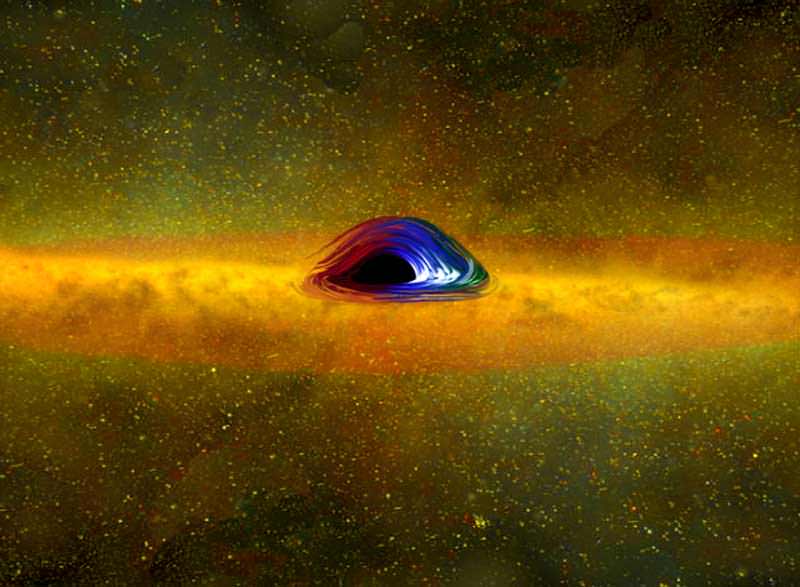
The science pictures below shows the black hole.


More About it
History


Simulation of gravitational lensing by a black hole, which distorts the image of a galaxy in the background (larger animation)
The idea of a body so massive that even light could not escape was first put forward by geologist John Michell in a letter written to Henry Cavendish in 1783 to the Royal Society:
If the semi-diameter of a sphere of the same density as the Sun were to exceed that of the Sun in the proportion of 500 to 1, a body falling from an infinite height towards it would have acquired at its surface greater velocity than that of light, and consequently supposing light to be attracted by the same force in proportion to its vis inertiae, with other bodies, all light emitted from such a body would be made to return towards it by its own proper gravity.
—John Michell[2]
In 1796, mathematician Pierre-Simon Laplace promoted the same idea in the first and second editions of his book Exposition du système du Monde (it was removed from later editions).[3][4] Such "dark stars" were largely ignored in the nineteenth century, since it was not understood how a massless wave such as light could be influenced by gravity.[5]
General relativity
In 1915, Albert Einstein developed his theory of general relativity, having earlier shown that gravity does influence light's motion. Only a few months later, Karl Schwarzschild found a solution to Einstein field equations, which describes the gravitational field of a point mass and a spherical mass.[6] A few months after Schwarzschild, Johannes Droste, a student of Hendrik Lorentz, independently gave the same solution for the point mass and wrote more extensively about its properties.[7] This solution had a peculiar behaviour at what is now called the Schwarzschild radius, where it became singular, meaning that some of the terms in the Einstein equations became infinite. The nature of this surface was not quite understood at the time. In 1924, Arthur Eddington showed that the singularity disappeared after a change of coordinates (see Eddington–Finkelstein coordinates), although it took until 1933 for Georges Lemaître to realize that this meant the singularity at the Schwarzschild radius was an unphysical coordinate singularity.[8]
In 1931, Subrahmanyan Chandrasekhar calculated, using general relativity, that a non-rotating body of electron-degenerate matter above a certain limiting mass (now called the Chandrasekhar limit at 1.4 solar masses) must have an infinite density. In other words, the object must have a radius of zero.[9] His arguments were opposed by many of his contemporaries like Eddington and Lev Landau, who argued that some yet unknown mechanism would stop the collapse.[10] They were partly correct: a white dwarf slightly more massive than the Chandrasekhar limit will collapse into a neutron star,[11] which is itself stable because of the Pauli exclusion principle. But in 1939, Robert Oppenheimer and others predicted that neutron stars above approximately three solar masses (the Tolman–Oppenheimer–Volkoff limit) would collapse into black holes for the reasons presented by Chandrasekhar, and concluded that no law of physics was likely to intervene and stop at least some stars from collapsing to black holes.[12]
Oppenheimer and his co-authors interpreted the singularity at the boundary of the Schwarzschild radius as indicating that this was the boundary of a bubble in which time stopped. This is a valid point of view for external observers, but not for infalling observers. Because of this property, the collapsed stars were called "frozen stars,"[13] because an outside observer would see the surface of the star frozen in time at the instant where its collapse takes it inside the Schwarzschild radius.
Golden age
See also: Golden age of general relativity
In 1958, David Finkelstein identified the Schwarzschild surface as an event horizon, "a perfect unidirectional membrane: causal influences can cross it in only one direction".[14] This did not strictly contradict Oppenheimer's results, but extended them to include the point of view of infalling observers. Finkelstein's solution extended the Schwarzschild solution for the future of observers falling into a black hole. A complete extension had already been found by Martin Kruskal, who was urged to publish it.[15]
These results came at the beginning of the golden age of general relativity, which was marked by general relativity and black holes becoming mainstream subjects of research. This process was helped by the discovery of pulsars in 1967,[16][17] which were shown to be rapidly rotating neutron stars by 1969.[18] Until that time, neutron stars, like black holes, were regarded as just theoretical curiosities; but the discovery of pulsars showed their physical relevance and spurred a further interest in all types of compact objects that might be formed by gravitational collapse.
In this period more general black hole solutions were found. In 1963, Roy Kerr found the exact solution for a rotating black hole. Two years later, Ezra Newman found the axisymmetric solution for a black hole that is both rotating and electrically charged.[19] Through the work of Werner Israel,[20] Brandon Carter,[21][22] and David Robinson[23] the no-hair theorem emerged, stating that a stationary black hole solution is completely described by the three parameters of the Kerr–Newman metric; mass, angular momentum, and electric charge.[24]
For a long time, it was suspected that the strange features of the black hole solutions were pathological artefacts from the symmetry conditions imposed, and that the singularities would not appear in generic situations. This view was held in particular by Vladimir Belinsky, Isaak Khalatnikov, and Evgeny Lifshitz, who tried to prove that no singularities appear in generic solutions. However, in the late sixties Roger Penrose[25] and Stephen Hawking used global techniques to prove that singularities are generic.[26]
Work by James Bardeen, Jacob Bekenstein, Carter, and Hawking in the early 1970s led to the formulation of black hole thermodynamics.[27] These laws describe the behaviour of a black hole in close analogy to the laws of thermodynamics by relating mass to energy, area to entropy, and surface gravity to temperature. The analogy was completed when Hawking, in 1974, showed that quantum field theory predicts that black holes should radiate like a black body with a temperature proportional to the surface gravity of the black hole.[28]
The term "black hole" was first publicly used by John Wheeler during a lecture in 1967. Although he is usually credited with coining the phrase, he always insisted that it was suggested to him by somebody else. The first recorded use of the term is in a 1964 letter by Anne Ewing to the American Association for the Advancement of Science.[29] After Wheeler's use of the term, it was quickly adopted in general use.
Properties and structure

The no-hair theorem states that, once it achieves a stable condition after formation, a black hole has only three independent physical properties: mass, charge, and angular momentum.[24] Any two black holes that share the same values for these properties, or parameters, are indistinguishable according to classical (i.e. non-quantum) mechanics.
These properties are special because they are visible from outside a black hole. For example, a charged black hole repels other like charges just like any other charged object. Similarly, the total mass inside a sphere containing a black hole can be found by using the gravitational analog of Gauss's law, the ADM mass, far away from the black hole.[30] Likewise, the angular momentum can be measured from far away using frame dragging by the gravitomagnetic field.
When an object falls into a black hole, any information about the shape of the object or distribution of charge on it is evenly distributed along the horizon of the black hole, and is lost to outside observers. The behavior of the horizon in this situation is closely analogous to that of a conductive stretchy membrane with friction and electrical resistance, a dissipative system (see membrane paradigm).[31] This is different from other field theories like electromagnetism, which do not have any friction or resistivity at the microscopic level, because they are time-reversible. Because a black hole eventually achieves a stable state with only three parameters, there is no way to avoid losing information about the initial conditions: the gravitational and electric fields of a black hole give very little information about what went in. The information that is lost includes every quantity that cannot be measured far away from the black hole horizon, including the total baryon number, lepton number, and all the other nearly conserved pseudo-charges of particle physics. This behavior is so puzzling that it has been called the black hole information loss paradox.[32][33]
Physical properties
The simplest black holes have mass but neither electric charge nor angular momentum. These black holes are often referred to as Schwarzschild black holes after Karl Schwarzschild who discovered this solution in 1916.[6] According to Birkhoff's theorem, it is the only vacuum solution that is spherically symmetric.[34] This means that there is no observable difference between the gravitational field of such a black hole and that of any other spherical object of the same mass. The popular notion of a black hole "sucking in everything" in its surroundings is therefore only correct near a black hole's horizon; far away, the external gravitational field is identical to that of any other body of the same mass.[35][unreliable source?]
Solutions describing more general black holes also exist. Charged black holes are described by the Reissner–Nordström metric, while the Kerr metric describes a rotating black hole. The most general stationary black hole solution known is the Kerr–Newman metric, which describes a black hole with both charge and angular momentum.[36]
While the mass of a black hole can take any positive value, the charge and angular momentum are constrained by the mass. In Planck units, the total electric charge Q and the total angular momentum J are expected to satisfy

for a black hole of mass M. Black holes saturating this inequality are called extremal. Solutions of Einstein's equations violating the inequality exist, but do not have a horizon. These solutions have naked singularities and are deemed unphysical. The cosmic censorship hypothesis rules out the formation of such singularities through the gravitational collapse of realistic matter.[37] This is supported by numerical simulations.[38]
Due to the relatively large strength of the electromagnetic force, black holes forming from the collapse of stars are expected to retain the nearly neutral charge of the star. Rotation, however, is expected to be a common feature of compact objects, and the black-hole candidate binary X-ray source GRS 1915+105[39] appears to have an angular momentum near the maximum allowed value.
Class Mass Size
Supermassive black hole ~105–109 MSun ~0.001–10 AU
Intermediate-mass black hole ~103 MSun ~103 km = REarth
Stellar black hole ~10 MSun ~30 km
Micro black hole up to ~MMoon up to ~0.1 mm
Black holes are commonly classified according to their mass, independent of angular momentum J or electric charge Q. The size of a black hole, as determined by the radius of the event horizon, or Schwarzschild radius, is roughly proportional to the mass M through

where rsh is the Schwarzschild radius and MSun is the mass of the Sun.[40] This relation is exact only for black holes with zero charge and angular momentum, for more general black holes it can differ up to a factor of 2. The table on the right lists the various classes of black hole that are distinguished.
Event horizon
Main article: Event horizon

Far away from the black hole a particle can move in any direction. It is only restricted by the speed of light.

Closer to the black hole spacetime starts to deform. In some convenient coordinate systems, there are more paths going towards the black hole than paths moving away.[Note 1]

Inside of the event horizon all paths bring the particle closer to the center of the black hole. It is no longer possible for the particle to escape.
The defining feature of a black hole is the appearance of an event horizon—a boundary in spacetime through which matter and light can only pass inward towards the mass of the black hole. Nothing, not even light, can escape from inside the event horizon. The event horizon is referred to as such because if an event occurs within the boundary, information from that event cannot reach an outside observer, making it impossible to determine if such an event occurred.[42]
As predicted by general relativity, the presence of a large mass deforms spacetime in such a way that the paths taken by particles bend towards the mass.[citation needed] At the event horizon of a black hole, this deformation becomes so strong that there are no paths that lead away from the black hole.
To a distant observer, clocks near a black hole appear to tick more slowly than those further away from the black hole.[43] Due to this effect, known as gravitational time dilation, an object falling into a black hole appears to slow down as it approaches the event horizon, taking an infinite time to reach it.[44] At the same time, all processes on this object slow down causing emitted light to appear redder and dimmer, an effect known as gravitational redshift.[45] Eventually, at a point just before it reaches the event horizon, the falling object becomes so dim that it can no longer be seen.
On the other hand, an observer falling into a black hole does not notice any of these effects as he crosses the event horizon. According to his own clock, he crosses the event horizon after a finite time, although he is unable to determine exactly when he crosses it, as it is impossible to determine the location of the event horizon from local observations.[46]
The shape of the event horizon of a black hole is always approximately spherical.[Note 2][49] For non-rotating (static) black holes the geometry is precisely spherical, while for rotating black holes the sphere is somewhat oblated.
Singularity
Main article: Gravitational singularity
At the center of a black hole as described by general relativity lies a gravitational singularity, a region where the spacetime curvature becomes infinite.[50] For a non-rotating black hole this region takes the shape of a single point and for a rotating black hole it is smeared out to form a ring singularity lying in the plane of rotation.[51] In both cases the singular region has zero volume. It can also be shown that the singular region contains all the mass of the black hole solution.[52] The singular region can thus be thought of as having infinite density.
An observer falling into a Schwarzschild black hole (i.e. non-rotating and no charges) cannot avoid being carried into the singularity, once they cross the event horizon. They can prolong the experience by accelerating away to slow their descent, but only up to a point; after attaining a certain ideal velocity, it is best to free fall the rest of the way.[53] When they reach the singularity, they are crushed to infinite density and their mass is added to the total of the black hole. Before that happens, they will have been torn apart by the growing tidal forces in a process sometimes referred to as spaghettification or the noodle effect.[54]
In the case of a charged (Reissner–Nordström) or rotating (Kerr) black hole it is possible to avoid the singularity. Extending these solutions as far as possible reveals the hypothetical possibility of exiting the black hole into a different spacetime with the black hole acting as a wormhole.[55] The possibility of traveling to another universe is however only theoretical, since any perturbation will destroy this possibility.[56] It also appears to be possible to follow closed timelike curves (going back to one's own past) around the Kerr singularity, which lead to problems with causality like the grandfather paradox.[57] It is expected that none of these peculiar effects would survive in a proper quantum mechanical treatment of rotating and charged black holes.[58]
The appearance of singularities in general relativity is commonly perceived as signaling the breakdown of the theory.[59] This breakdown, however, is expected; it occurs in a situation where quantum mechanical effects should describe these actions due to the extremely high density and therefore particle interactions. To date it has not been possible to combine quantum and gravitational effects into a single theory. It is generally expected that a theory of quantum gravity will feature black holes without singularities.[60][61]
Photon sphere
Main article: Photon sphere
The photon sphere is a spherical boundary of zero thickness such that photons moving along tangents to the sphere will be trapped in a circular orbit. For non-rotating black holes, the photon sphere has a radius 1.5 times the Schwarzschild radius. The orbits are dynamically unstable, hence any small perturbation (such as a particle of infalling matter) will grow over time, either setting it on an outward trajectory escaping the black hole or on an inward spiral eventually crossing the event horizon.
While light can still escape from inside the photon sphere, any light that crosses the photon sphere on an inbound trajectory will be captured by the black hole. Hence any light reaching an outside observer from inside the photon sphere must have been emitted by objects inside the photon sphere but still outside of the event horizon.
Other compact objects, such as neutron stars, can also have photon spheres.[62] This follows from the fact that the gravitational field of an object does not depend on its actual size, hence any object that is smaller than 1.5 times the Schwarzschild radius corresponding to its mass will indeed have a photon sphere.
Ergosphere
Main article: Ergosphere


The ergosphere is an oblate spheroid region outside of the event horizon, where objects cannot remain stationary.
Rotating black holes are surrounded by a region of spacetime in which it is impossible to stand still, called the ergosphere. This is the result of a process known as frame-dragging; general relativity predicts that any rotating mass will tend to slightly "drag" along the spacetime immediately surrounding it. Any object near the rotating mass will tend to start moving in the direction of rotation. For a rotating black hole this effect becomes so strong near the event horizon that an object would have to move faster than the speed of light in the opposite direction to just stand still.[63]
The ergosphere of a black hole is bounded by the (outer) event horizon on the inside and an oblate spheroid, which coincides with the event horizon at the poles and is noticeably wider around the equator. The outer boundary is sometimes called the ergosurface.
Objects and radiation can escape normally from the ergosphere. Through the Penrose process, objects can emerge from the ergosphere with more energy than they entered. This energy is taken from the rotational energy of the black hole causing it to slow down.[64]
Formation and evolution

Considering the exotic nature of black holes, it may be natural to question if such bizarre objects could exist in nature or to suggest that they are merely pathological solutions to Einstein's equations. Einstein himself wrongly thought that black holes would not form, because he held that the angular momentum of collapsing particles would stabilize their motion at some radius.[65] This led the general relativity community to dismiss all results to the contrary for many years. However, a minority of relativists continued to contend that black holes were physical objects,[66] and by the end of the 1960s, they had persuaded the majority of researchers in the field that there is no obstacle to forming an event horizon.
Once an event horizon forms, Penrose proved that a singularity will form somewhere inside it.[25] Shortly afterwards, Hawking showed that many cosmological solutions describing the Big Bang have singularities without scalar fields or other exotic matter (see Penrose-Hawking singularity theorems). The Kerr solution, the no-hair theorem and the laws of black hole thermodynamics showed that the physical properties of black holes were simple and comprehensible, making them respectable subjects for research.[67] The primary formation process for black holes is expected to be the gravitational collapse of heavy objects such as stars, but there are also more exotic processes that can lead to the production of black holes.
Gravitational collapse
Main article: Gravitational collapse
Gravitational collapse occurs when an object's internal pressure is insufficient to resist the object's own gravity. For stars this usually occurs either because a star has too little "fuel" left to maintain its temperature through stellar nucleosynthesis, or because a star that would have been stable receives extra matter in a way that does not raise its core temperature. In either case the star's temperature is no longer high enough to prevent it from collapsing under its own weight (the ideal gas law explains the connection between pressure, temperature, and volume).[68]
The collapse may be stopped by the degeneracy pressure of the star's constituents, condensing the matter in an exotic denser state. The result is one of the various types of compact star. Which type of compact star is formed depends on the mass of the remnant—the matter left over after changes triggered by the collapse (such as supernova or pulsations leading to a planetary nebula) have blown away the outer layers. Note that this can be substantially less than the original star—remnants exceeding 5 solar masses are produced by stars that were over 20 solar masses before the collapse.[68]
If the mass of the remnant exceeds about 3–4 solar masses (the Tolman–Oppenheimer–Volkoff limit[12])—either because the original star was very heavy or because the remnant collected additional mass through accretion of matter—even the degeneracy pressure of neutrons is insufficient to stop the collapse. After this, no known mechanism (except possibly quark degeneracy pressure, see quark star) is powerful enough to stop the collapse and the object will inevitably collapse to a black hole.[68]
This gravitational collapse of heavy stars is assumed to be responsible for the formation of stellar mass black holes. Star formation in the young universe may have resulted in very heavy stars, which upon their collapse would have produced black holes of up to 103 solar masses. These heavy black holes could be the seeds of the supermassive black holes found in the centers of most galaxies.[69]
While most of the energy released during gravitational collapse is emitted very quickly, an outside observer does not actually see the end of this process. Even though the collapse takes a finite amount of time from the reference frame of infalling matter, a distant observer sees the infalling material slow and halt just above the event horizon, due to gravitational time dilation. Light from the collapsing material takes longer and longer to reach the observer, with the light emitted just before the event horizon forms delayed an infinite amount of time. Thus the external observer never sees the formation of the event horizon; instead, the collapsing material seems to become dimmer and increasingly red-shifted, eventually fading away.[70]
Primordial black holes in the Big Bang
Gravitational collapse requires great densities. In the current epoch of the universe these high densities are only found in stars, but in the early universe shortly after the big bang densities were much greater, possibly allowing for the creation of black holes. The high density alone is not enough to allow the formation of black holes since a uniform mass distribution will not allow the mass to bunch up. In order for primordial black holes to form in such a dense medium, there must be initial density perturbations that can then grow under their own gravity. Different models for the early universe vary widely in their predictions of the size of these perturbations. Various models predict the creation of black holes, ranging from a Planck mass to hundreds of thousands of solar masses.[71] Primordial black holes could thus account for the creation of any type of black hole.
High-energy collisions


A simulated event in the CMS detector, a collision in which a micro black hole may be created.
Gravitational collapse is not the only process that could create black holes. In principle, black holes could also be created in high-energy collisions that create sufficient density. However, to date, no such events have ever been detected either directly or indirectly as a deficiency of the mass balance in particle accelerator experiments.[72] This suggests that there must be a lower limit for the mass of black holes. Theoretically, this boundary is expected to lie around the Planck mass (mP = √ħc/G ≈ 1.2×10¹⁹
GeV/c2 ≈ 2.2×10⁻⁸
kg), where quantum effects are expected to make the theory of general relativity break down completely.[73] This would put the creation of black holes firmly out of reach of any high energy process occurring on or near the Earth. Certain developments in quantum gravity however suggest that the Planck mass could be much lower: some braneworld scenarios for example put it much lower, maybe even as low as 1 TeV/c2[74] This would make it possible for micro black holes to be created in the high energy collisions occurring when cosmic rays hit the Earth's atmosphere, or possibly in the new Large Hadron Collider at CERN. These theories are however very speculative, and the creation of black holes in these processes is deemed unlikely by many specialists.[75] Even if such micro black holes should be formed in these collisions, it is expected that they would evaporate in about 10−25 seconds, posing no threat to Earth.[76]
Growth
Once a black hole has formed, it can continue to grow by absorbing additional matter. Any black hole will continually absorb gas and interstellar dust from its direct surroundings and omnipresent cosmic background radiation. This is the primary process through which supermassive black holes seem to have grown.[69] A similar process has been suggested for the formation of intermediate-mass black holes in globular clusters.[77]
Another possibility is for a black hole to merge with other objects such as stars or even other black holes. This is thought to have been important especially for the early development of supermassive black holes, which are thought to have formed from the coagulation of many smaller objects.[69] The process has also been proposed as the origin of some intermediate-mass black holes.[78][79]
Evaporation
Main article: Hawking radiation
In 1974, Hawking showed that black holes are not entirely black but emit small amounts of thermal radiation.[28] He got this result by applying quantum field theory in a static black hole background. The result of his calculations is that a black hole should emit particles in a perfect black body spectrum. This effect has become known as Hawking radiation. Since Hawking's result, many others have verified the effect through various methods.[80] If his theory of black hole radiation is correct, then black holes are expected to emit a thermal spectrum of radiation, and thereby lose mass, because according to the theory of relativity mass is a form of energy (E = mc2).[28] Black holes will shrink and evaporate over time. The temperature of this spectrum (Hawking temperature) is proportional to the surface gravity of the black hole, which for a Schwarzschild black hole is inversely proportional to the mass. Large black holes, therefore, emit less radiation than small black holes.[81]
A stellar black hole of one solar mass has a Hawking temperature of about 100 nanokelvins. This is far less than the 2.7 K temperature of the cosmic microwave background. Stellar mass (and larger) black holes receive more mass from the cosmic microwave background than they emit through Hawking radiation and will thus grow instead of shrink. To have a Hawking temperature larger than 2.7 K (and be able to evaporate), a black hole needs to be lighter than the Moon (and therefore a diameter of less than a tenth of a millimeter).[82]
On the other hand, if a black hole is very small the radiation effects are expected to become very strong. Even a black hole that is heavy compared to a human would evaporate in an instant. A black hole the weight of a car (~10−24 m) would only take a nanosecond to evaporate, during which time it would briefly have a luminosity more than 200 times that of the sun. Lighter black holes are expected to evaporate even faster, for example a black hole of mass 1 TeV/c2 would take less than 10−88 seconds to evaporate completely. Of course, for such a small black hole quantum gravitation effects are expected to play an important role and could even – although current developments in quantum gravity do not indicate so[83] – hypothetically make such a small black hole stable.[84]
Observational evidence

By their very nature, black holes do not directly emit any signals other than the hypothetical Hawking radiation; since the Hawking radiation for an astrophysical black hole is predicted to be very weak, this makes it impossible to directly detect astrophysical black holes from the Earth. A possible exception to the Hawking radiation being weak is the last stage of the evaporation of light (primordial) black holes; searches for such flashes in the past has proven unsuccessful and provides stringent limits on the possibility of existence of light primordial black holes.[85] NASA's Fermi Gamma-ray Space Telescope launched in 2008 will continue the search for these flashes.[86]
Astrophysicists searching for black holes thus have to rely on indirect observations. A black hole's existence can sometimes be inferred by observing its gravitational interactions with its surroundings.
Accretion of matter
See also: Accretion disc


Formation of extragalactic jets from a black hole's accretion disk
Due to conservation of angular momentum, gas falling into the gravitational well created by a massive object will typically form a disc-like structure around the object. Friction within the disc causes angular momentum to be transported outward allowing matter to fall further inward releasing potential energy and increasing the temperature of the gas.[87] In the case of compact objects such as white dwarfs, neutron stars, and black holes, the gas in the inner regions becomes so hot that it will emit vast amounts of radiation (mainly X-rays), which may be detected by telescopes. This process of accretion is one of the most efficient energy producing process known; up to 40% of the rest mass of the accreted material can be emitted in radiation.[87] (In nuclear fusion only about 0.7% of the rest mass will be emitted as energy.) In many cases, accretion discs are accompanied by relativistic jets emitted along the poles, which carry away much of the energy. The mechanism for the creation of these jets is currently not well understood.
As such many of the universe's more energetic phenomena have been attributed to the accretion of matter on black holes. In particular, active galactic nuclei and quasars are thought to be the accretion discs of supermassive black holes.[88] Similarly, X-ray binaries are thought to be binary star systems in which one of the two stars is a compact object accreting matter from its companion.[88] It has also been suggested that some ultraluminous X-ray sources may be the accretion disks of intermediate-mass black holes.[89]
X-ray binaries
See also: X-ray binary
X-ray binaries are binary star systems that are luminous in the X-ray part of the spectrum. These X-ray emissions are generally thought to be caused by one of the component stars being a compact object accreting matter from the other (regular) star. The presence of an ordinary star in such a system provides a unique opportunity for studying the central object and determining if it might be a black hole.


Artist impression of a binary system with an accretion disk around a compact object being fed by material from the companion star.
If such a system emits signals that can be directly traced back to the compact object, it cannot be a black hole. The absence of such a signal does, however, not exclude the possibility that the compact object is a neutron star. By studying the companion star it is often possible to obtain the orbital parameters of the system and obtain an estimate for the mass of the compact object. If this is much larger than the Tolman–Oppenheimer–Volkoff limit (that is, the maximum mass a neutron star can have before collapsing) then the object cannot be a neutron star and is generally expected to be a black hole.[88]
The first strong candidate for a black hole, Cygnus X-1, was discovered in this way by Charles Thomas Bolton[90] and Louise Webster and Paul Murdin[91] in 1972.[92][93] Some doubt, however, remained due to the uncertainties resultant from the companion star being much heavier than the candidate black hole.[88] Currently, better candidates for black holes are found in a class of X-ray binaries called soft X-ray transients.[88] In this class of system the companion star is relatively low mass allowing for more accurate estimates in the black hole mass. Moreover, these systems are only active in X-ray for several months once every 10–50 years. During the period of low X-ray emission (called quiescence), the accretion disc is extremely faint allowing for detailed observation of the companion star during this period. One of the best such candidates is V404 Cyg.
Quiescence and advection-dominated accretion flow
The faintness of the accretion disc during quiescence is thought to be caused by the flow entering a mode called an advection-dominated accretion flow (ADAF). In this mode, almost all the energy generated by friction in the disc is swept along with the flow instead of radiated away. If this model is correct, then it forms strong qualitative evidence for the presence of an event horizon.[94] Because, if the object at the center of the disc had a solid surface, it would emit large amounts of radiation as the highly energetic gas hits the surface, an effect that is observed for neutron stars in a similar state.[87]
Quasi-periodic oscillations
Main article: Quasi-periodic oscillations
The X-ray emission from accretion disks sometimes flickers at certain frequencies. These signals are called quasi-periodic oscillations and are thought to be caused by material moving along the inner edge of the accretion disk (the innermost stable circular orbit). As such their frequency is linked to the mass of the compact object. They can thus be used as an alternative way to determine the mass of potential black holes.[95]
Galactic nuclei
See also: Active galactic nucleus


The jet originating from the center of M87 in this image comes from an active galactic nucleus that may contain a supermassive black hole. Credit: Hubble Space Telescope/NASA/ESA.
Astronomers use the term "active galaxy" to describe galaxies with unusual characteristics, such as unusual spectral line emission and very strong radio emission. Theoretical and observational studies have shown that the activity in these active galactic nuclei (AGN) may be explained by the presence of supermassive black holes. The models of these AGN consist of a central black hole that may be millions or billions of times more massive than the Sun; a disk of gas and dust called an accretion disk; and two jets that are perpendicular to the accretion disk.[96][97]
Although supermassive black holes are expected to be found in most AGN, only some galaxies' nuclei have been more carefully studied in attempts to both identify and measure the actual masses of the central supermassive black hole candidates. Some of the most notable galaxies with supermassive black hole candidates include the Andromeda Galaxy, M32, M87, NGC 3115, NGC 3377, NGC 4258, and the Sombrero Galaxy.[98]
It is now widely accepted that the center of (nearly) every galaxy (not just active ones) contains a supermassive black hole.[99] The close observational correlation between the mass of this hole and the velocity dispersion of the host galaxy's bulge, known as the M-sigma relation, strongly suggests a connection between the formation of the black hole and the galaxy itself. [100]
Currently, the best evidence for a supermassive black hole comes from studying the proper motion of stars near the center of our own Milky Way.[101] Since 1995 astronomers have tracked the motion of 90 stars in a region called Sagittarius A*. By fitting their motion to Keplerian orbits they were able to infer in 1998 that 2.6 million solar masses must be contained in a volume with a radius of 0.02 lightyears.[102] Since then one of the stars—called S2—has completed a full orbit. From the orbital data they were able to place better constraints on the mass and size of the object causing the orbital motion of stars in the Sagittarius A* region, finding that there is a spherical mass of 4.3 million solar masses contained within a radius of less than 0.002 lightyears.[101] While this is more than 3000 times the Schwarzschild radius corresponding to that mass, it is at least consistent with the central object being a supermassive black hole, and no "realistic cluster [of stars] is physically tenable."[102]
Gravitational lensing
Further information: Gravitational lens
The deformation of spacetime around a massive object causes light rays to be deflected much like light passing through an optic lens. This phenomenon is known as gravitational lensing. Observations have been made of weak gravitational lensing, in which photons are deflected by only a few arcseconds. However, it has never been directly observed for a black hole.[103] One possibility for observing gravitational lensing by a black hole would be to observe stars in orbit around the black hole. There are several candidates for such an observation in orbit around Sagittarius A*.[103]
Alternatives
The evidence for stellar black holes strongly relies on the existence of an upper limit for the mass of a neutron star. The size of this limit heavily depends on the assumptions made about the properties of dense matter. New exotic phases of matter could push up this bound.[88] A phase of free quarks at high density might allow the existence of dense quark stars,[104] and some supersymmetric models predict the existence of Q stars.[105] Some extensions of the standard model posit the existence of preons as fundamental building blocks of quarks and leptons, which could hypothetically form preon stars.[106] These hypothetical models could potentially explain a number of observations of stellar black hole candidates. However, it can be shown from general arguments in general relativity that any such object will have a maximum mass.[88]
Since the average density of a black hole inside its Schwarzschild radius is inversely proportional to the square of its mass, supermassive black holes are much less dense than stellar black holes (the average density of a 108 solar mass black hole is comparable to that of water).[88] Consequently, the physics of matter forming a supermassive black hole is much better understood and the possible alternative explanations for supermassive black hole observations are much more mundane. For example, a supermassive black hole could be modelled by a large cluster of very dark objects. However, typically such alternatives are not stable enough to explain the supermassive black hole candidates.[88]
The evidence for stellar and supermassive black holes implies that in order for black holes not to form, general relativity must fail as a theory of gravity, perhaps due to the onset of quantum mechanical corrections. A much anticipated feature of a theory of quantum gravity is that it will not feature singularities or event horizons (and thus no black holes).[107] In recent years, much attention has been drawn by the fuzzball model in string theory. Based on calculations in specific situations in string theory, the proposal suggest that generically the individual states of a black hole solution do not have an event horizon or singularity (and can thus not really be considered to be a black hole), but that for a distant observer the statistical average of such states does appear just like an ordinary black hole in general relativity.[108]
Open questions

Entropy and thermodynamics
Further information: Black hole thermodynamics


The formula for the Bekenstein–Hawking entropy (S) of a black hole. It depends on the area of the black hole (A), the speed of light (c), the Boltzman constant (k), Newton's constant (G), and the reduced Planck constant (ħ).
In 1971, Hawking showed under general conditions[Note 3] that the total area of the event horizons of any collection of classical black holes can never decrease, even if they collide and merge.[109] This result, now known as the second law of black hole mechanics, is remarkably similar to the second law of thermodynamics, which states that the total entropy of a system can never decrease. As with classical objects at absolute zero temperature, it was assumed that black holes had zero entropy. If this were the case, the second law of thermodynamics would be violated by entropy-laden matter entering a black hole, resulting in a decrease of the total entropy of the universe. Therefore, Bekenstein proposed that a black hole should have an entropy, and that it should be proportional to its horizon area.[110]
The link with the laws of thermodynamics was further strengthened by Hawking's discovery that quantum field theory predicts that a black hole radiates blackbody radiation at a constant temperature. This seemingly causes a violation of the second law of black hole mechanics, since the radiation will carry away energy from the black hole causing it to shrink. The radiation, however also carries away entropy, and it can be proven under general assumptions that the sum of the entropy of the matter surrounding a black hole and one quarter of the area of the horizon as measured in Planck units is in fact always increasing. This allows the formulation of the first law of black hole mechanics as an analogue of the first law of thermodynamics, with the mass acting as energy, the surface gravity as temperature and the area as entropy.[110]
One puzzling feature is that the entropy of a black hole scales with its area rather than with its volume, since entropy is normally an extensive quantity that scales linearly with the volume of the system. This odd property led Gerard 't Hooft and Leonard Susskind to propose the holographic principle, which suggests that anything that happens in volume of spacetime can be described by data on the boundary of that volume.[111]
Although general relativity can be used to perform a semi-classical calculation of black hole entropy, this situation is theoretically unsatisfying. In statistical mechanics, entropy is understood as counting the number of microscopic configurations of a system that have the same macroscopic qualities (such as mass, charge, pressure, etc.). Without a satisfactory theory of quantum gravity, one cannot perform such a computation for black holes. Some progress has been made in various approaches to quantum gravity. In 1995, Andrew Strominger and Cumrun Vafa showed that counting the microstates of a specific supersymmetric black hole in string theory reproduced the Bekenstein–Hawking entropy.[112] Since then, similar results have been reported for different black holes both in string theory and in other approaches to quantum gravity like loop quantum gravity.[113]
Black hole unitarity
Main article: Black hole information paradox
Unsolved problems in physics
Is physical information lost in black holes?
An open question in fundamental physics is the so-called information loss paradox, or black hole unitarity paradox. Classically, the laws of physics are the same run forward or in reverse (T-symmetry). Liouville's theorem dictates conservation of phase space volume, which can be thought of as "conservation of information", so there is some problem even in classical physics. In quantum mechanics, this corresponds to a vital property called unitarity, which has to do with the conservation of probability (it can also be thought of as a conservation of quantum phase space volume as expressed by the density matrix).[114]

LinkWithin

Related Posts Plugin for WordPress, Blogger...